
Welcome to the Echinoderm subsite on Invertebrate Paleontology!
Please enter a genera name to retrieve more information.
Pisocrinus
Classification
Phylum:
Echinodermata
Subphylum:
Crinozoa
Class:
Crinoidea
Subclass:
Inadunata
Order:
Disparida
Suborder:
Disparida
Superfamily:
Pisocrinacea
Family:
Pisocrinidea
Formal Genus Name and Reference:
Pisocrinus de KONINCK, 1858, p. 104
Type Species:
P. pilula
Images
(Click to enlarge in a new window)
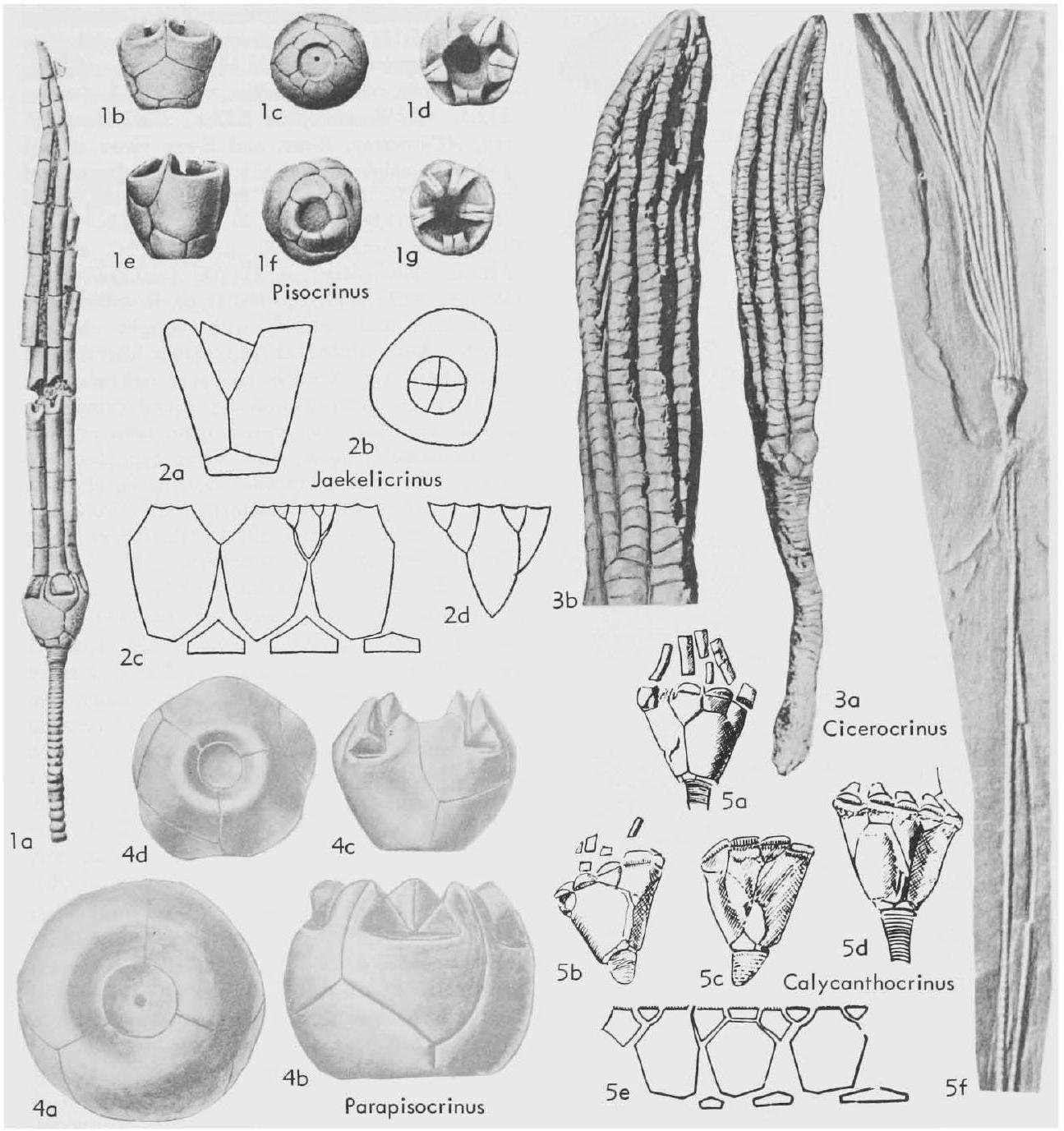 Fig. 332, 5. *C. decadactylus, L.Dev., Ger., 5a-d, Cray, A E-interray, B-ray, and E-ray views of cup and proximal brachials, x1, 5 e, plate diagram of cup, x1, 5 f, lat. view of crown and stem, x0.5 (Schmidt, 1934)
Synonyms
Triacrinus
Geographic Distribution
Eu. (Ger.)
Age Range
Beginning Stage in Treatise Usage:
L.Dev.
Beginning International Stage:
Lochkovian
Fraction Up In Beginning Stage:
0
Beginning Date:
419
Ending Stage in Treatise Usage:
M.Dev.
Ending International Stage:
Givetian
Fraction Up In Ending Stage:
100
Ending Date:
378.9
Description
Cup small, globose or rarely conical with flat base or basal concavity, basals 5, unequal in size, A E and B C basals smaller than other 3 basals and with truncated rather than acute distal edge. Radials unequal in size, C and E radials small, triangular and not in contact with basals, B ray with small triangular superradial and large inferradial which is shifted obliquely to left and situated directly above B C basal, D and A radials are large, simple, in contact with basals, and together with the B inferradial comprise most of the theca. Each of these 4 extra plates as well as the 5 radials bears a long, slender, atomous arm so that nine arms are present in the crown. Anal X a small plate at the upper right corner of D radial, anal sac not known.
References
Museum or Author Information
Classification
Phylum:
Echinodermata
Subphylum:
Crinozoa
Class:
Crinoidea
Subclass:
Inadunata
Order:
Disparida
Suborder:
Disparida
Superfamily:
Pisocrinacea
Family:
Pisocrinidea
Formal Genus Name and Reference:
Pisocrinus de KONINCK, 1858, p. 104
Type Species:
P. pilula
Images
(Click to enlarge in a new window)
Fig. 332, 5. *C. decadactylus, L.Dev., Ger., 5a-d, Cray, A E-interray, B-ray, and E-ray views of cup and proximal brachials, x1, 5 e, plate diagram of cup, x1, 5 f, lat. view of crown and stem, x0.5 (Schmidt, 1934)
Synonyms
Triacrinus
Geographic Distribution
Eu. (Ger.)
Age Range
Beginning Stage in Treatise Usage:
L.Dev.
Beginning International Stage:
Lochkovian
Fraction Up In Beginning Stage:
0
Beginning Date:
419
Ending Stage in Treatise Usage:
M.Dev.
Ending International Stage:
Givetian
Fraction Up In Ending Stage:
100
Ending Date:
378.9
Description
Cup small, globose or rarely conical with flat base or basal concavity, basals 5, unequal in size, A E and B C basals smaller than other 3 basals and with truncated rather than acute distal edge. Radials unequal in size, C and E radials small, triangular and not in contact with basals, B ray with small triangular superradial and large inferradial which is shifted obliquely to left and situated directly above B C basal, D and A radials are large, simple, in contact with basals, and together with the B inferradial comprise most of the theca. Each of these 4 extra plates as well as the 5 radials bears a long, slender, atomous arm so that nine arms are present in the crown. Anal X a small plate at the upper right corner of D radial, anal sac not known.