
Welcome to the Echinoderm subsite on Invertebrate Paleontology!
Please enter a genera name to retrieve more information.
Hydriocrinus
Classification
Phylum:
Echinodermata
Subphylum:
Crinozoa
Class:
Crinoidea
Subclass:
Inadunata
Order:
Cladida
Suborder:
Poteriocrinina
Superfamily:
Scytalocrinacea
Family:
Scytalocrinidae
Formal Genus Name and Reference:
Hydriocrinus TRAUTSCHOLD, 1867, p. 16
Type Species:
H. pusillus, OD
Images
(Click to enlarge in a new window)
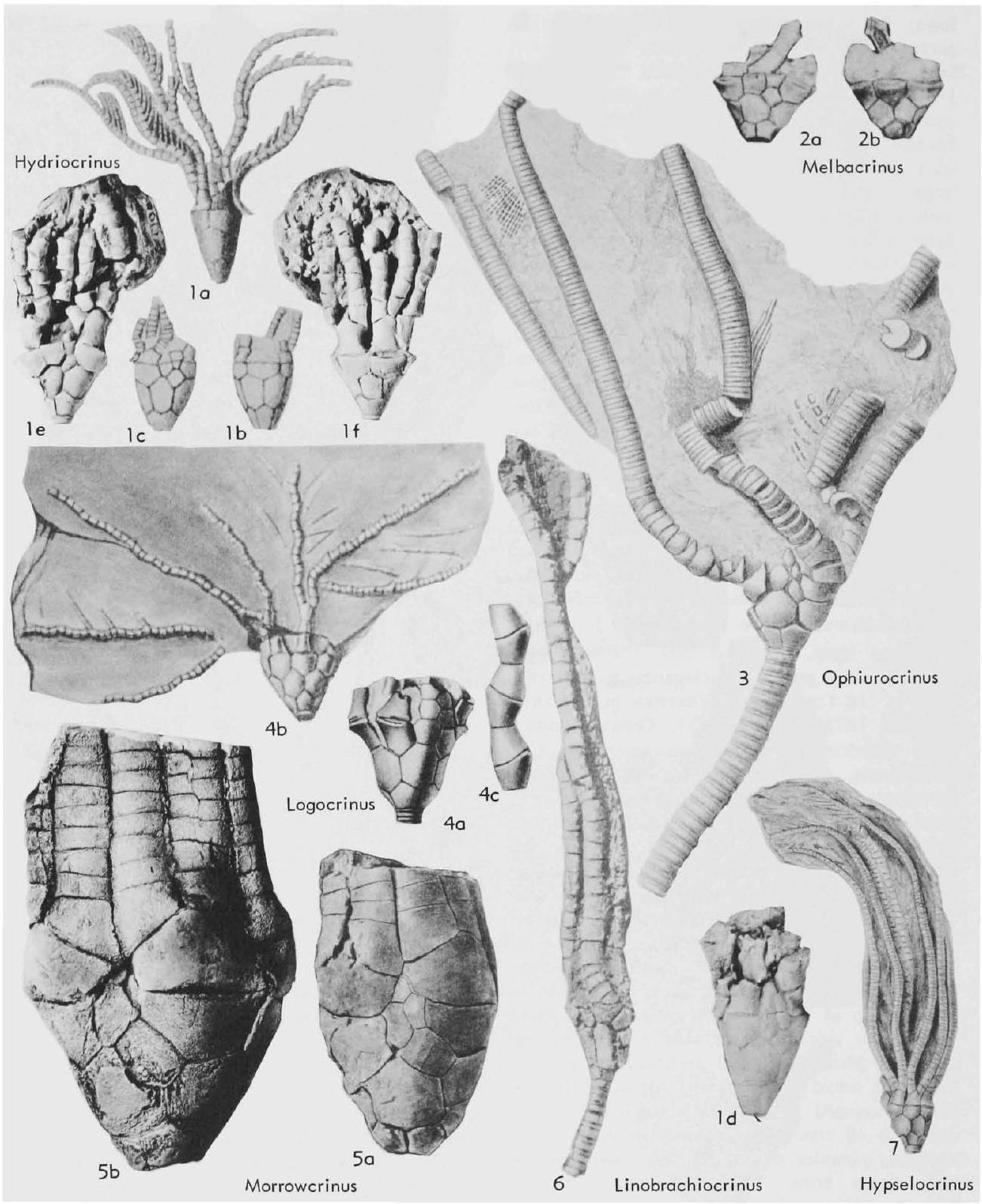 Fig. 421, 1a-d. *H. pusillus, U.Carb. (Moscov. ), Myachkovo, USSR, 1 a-c, ant. view of crown, ant. and post. views of cup, x0.93 (Trautschold, 1867), 1 d, topotype showing anal tube, x0.93 (Strimple, 1971d).-Fig. 421, 1e, f. H. turbinatus Strimple, U.Penn. (Missour., Wann F.), Okla., holotype crown from post. and ant. sides, x0.93 (Strimple, 1971d).
Synonyms
Geographic Distribution
U.Penn. (Missour. ), USA, U.Carb., USSR
Age Range
Beginning Stage in Treatise Usage:
U.Penn., U.Carb. (Missour.)
Beginning International Stage:
Kasimovian
Fraction Up In Beginning Stage:
0
Beginning Date:
307.02
Ending Stage in Treatise Usage:
U.Penn., U.Carb. (Missour.)
Ending International Stage:
Kasimovian
Fraction Up In Ending Stage:
57.7
Ending Date:
305.09
Description
Crown moderately tall, inverted pear shaped. Cup high conical, with 5 prominent, upflared infrabasals; articular facets of radials wide, sutures gaping; 3 anal plates with anal X in broad contact with CD basal and having an outer ligament pit for articulation with first tube plate, right tube plate on radianal, also with upper articulating facet, distal edges of anal X and right tube plate not extending appreciably above radial summits and forming a confluent plane. Anal sac small, cylindrical, composed of rows of diminutive plates. Arms slender with well-rounded exteriors, elongate cuneate brachiaIs with long side pinnule bearing; primibrachs I elongate, midsection slightly constricted, axillary; a second dichotomy may appear high in arms. Stem transversely pentagonal or subpentagonal at cup. [Hydriocrinus is thought to have evolved from Phacelocrinus and older forms assigned to the genus are probably not congeneric.]
References
Museum or Author Information
Classification
Phylum:
Echinodermata
Subphylum:
Crinozoa
Class:
Crinoidea
Subclass:
Inadunata
Order:
Cladida
Suborder:
Poteriocrinina
Superfamily:
Scytalocrinacea
Family:
Scytalocrinidae
Formal Genus Name and Reference:
Hydriocrinus TRAUTSCHOLD, 1867, p. 16
Type Species:
H. pusillus, OD
Images
(Click to enlarge in a new window)
Fig. 421, 1a-d. *H. pusillus, U.Carb. (Moscov. ), Myachkovo, USSR, 1 a-c, ant. view of crown, ant. and post. views of cup, x0.93 (Trautschold, 1867), 1 d, topotype showing anal tube, x0.93 (Strimple, 1971d).-Fig. 421, 1e, f. H. turbinatus Strimple, U.Penn. (Missour., Wann F.), Okla., holotype crown from post. and ant. sides, x0.93 (Strimple, 1971d).
Synonyms
Geographic Distribution
U.Penn. (Missour. ), USA, U.Carb., USSR
Age Range
Beginning Stage in Treatise Usage:
U.Penn., U.Carb. (Missour.)
Beginning International Stage:
Kasimovian
Fraction Up In Beginning Stage:
0
Beginning Date:
307.02
Ending Stage in Treatise Usage:
U.Penn., U.Carb. (Missour.)
Ending International Stage:
Kasimovian
Fraction Up In Ending Stage:
57.7
Ending Date:
305.09
Description
Crown moderately tall, inverted pear shaped. Cup high conical, with 5 prominent, upflared infrabasals; articular facets of radials wide, sutures gaping; 3 anal plates with anal X in broad contact with CD basal and having an outer ligament pit for articulation with first tube plate, right tube plate on radianal, also with upper articulating facet, distal edges of anal X and right tube plate not extending appreciably above radial summits and forming a confluent plane. Anal sac small, cylindrical, composed of rows of diminutive plates. Arms slender with well-rounded exteriors, elongate cuneate brachiaIs with long side pinnule bearing; primibrachs I elongate, midsection slightly constricted, axillary; a second dichotomy may appear high in arms. Stem transversely pentagonal or subpentagonal at cup. [Hydriocrinus is thought to have evolved from Phacelocrinus and older forms assigned to the genus are probably not congeneric.]