
Welcome to the Echinoderm subsite on Invertebrate Paleontology!
Please enter a genera name to retrieve more information.
Echinosphaerites
Classification
Phylum:
Echinodermata
Subphylum:
Crinozoa
Class:
Cystoidea
Order:
Rhombifera
Superfamily:
Caryocystitida
Family:
Echinosphaeritidae
Formal Genus Name and Reference:
Echinosphaerites WAHLENBERG, 1818, p. 44
Type Species:
Echinus aurantium Gyllenhaal, 1772, p. 245 (=Sphaeronites citrus Hisinger, 1837, p. 91, S. pomum Hisinger, 1828, p. 196, partim, Leucophthalmus strangwaysi KOENIG, 1825, pl. 1, fig. 1)
Images
(Click to enlarge in a new window)
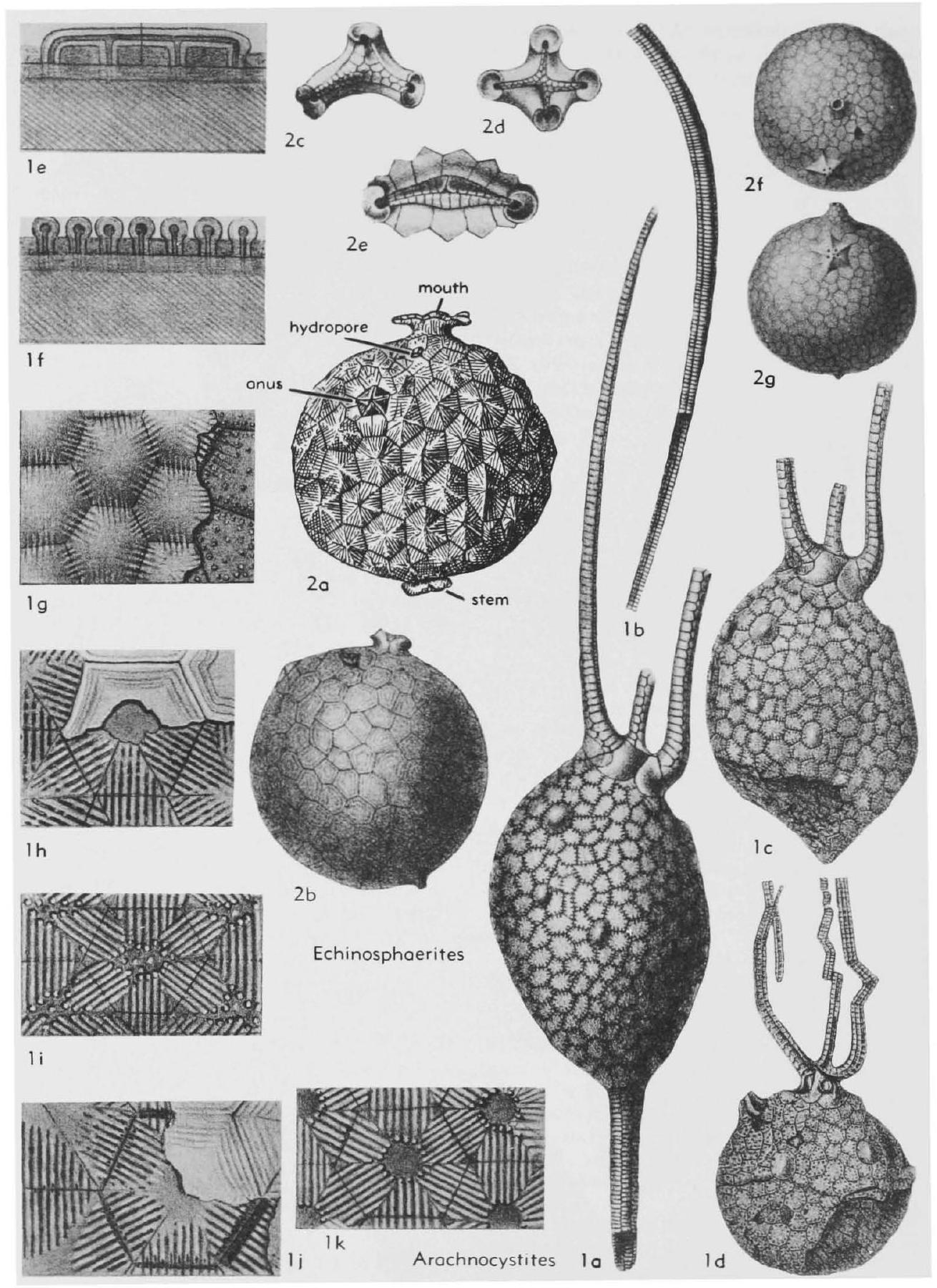 Fig. 132,2. *E. aurantium (GYLLENHAAL); 2a, reconstr., Xl1(10); 2b, reconstr., X1 (69); 2c-e, oral regions, 3 specimens, showing different numbers of brachiole facets, enl. (69); 2f,g, oral and lat., X1 (31). [See also Fig. 33,1; 37,3.]
Synonyms
Echinosphaera, Echinosphora, Deutocystites, Leucophthalmus, Citrocystis, Crystallocystis, Trinemacystis
Geographic Distribution
Asia (Burma-China) - Eu. (USSR-Est.-Sweden-NorwayPol.-Ger.-Belg.-Brit.-Boh.)-N.Am. (USA)
Age Range
Beginning Stage in Treatise Usage:
L.Ord.
Beginning International Stage:
Tremadocian
Fraction Up In Beginning Stage:
0
Beginning Date:
486.85
Ending Stage in Treatise Usage:
U. Ord.
Ending International Stage:
Hirnantian
Fraction Up In Ending Stage:
100
Ending Date:
443.07
Description
Theca in type and many other species subsphaeroidal, for which reason these abundant cystoids have long been called "crystal apples"; in some (e.g., E. pirum) theca aborally produced to attain pear shape. Adults composed of 200 to several hundred polygonal plates; one form with many plates hexagonal and nearly all subequal, and another form with considerable variation in size, with plates having 3 to as many as 10 sides, both forms occurring within same species. Tangential pore canals exposed on weathered specimens as very regular, straight grooves distributed in rhombic areas, each rhomb formed by 2 triangular sectors of adjacent plates and nearly filled by several equally spaced, subparallel grooves. Each end of tangential pore canal joined to vertical pore canal, commonly called pore, leading to interior of theca, fillings or casts of vertical canals commonly appearing as granules or short pegs on steinkerns of thecae. Tangential canals compound as a rule, 2 to 4 of them extending between paired pores. Tangential pore canals covered in well-preserved specimens by generally smooth epitheca of several thin laminae, each somewhat distinctively ornamented with concentric lines, probably growth lines. Brachiole facets upon peristomial or oral projection, which in many forms is emphasized by slight constriction giving oral field appearance of small platform resting upon neck. Ambulacra commonly arranged in triradiate or tetraradiate pattern, although specimens have been figured and reported with only 2 brachioles attached to facets at each end of narrow peristomialambulacral series of plates; ambulacra short, facets distinct, rimmed concavities; number of brachioles not constant within a species. Anal pyramid in upper part of theca, closed by variable number of triangular plates. Gonopore rounded to triangular, about half diameter of anal pyramid, closed by few valvular plates in form of flat pyramid; gonopore offset to right from line connecting mouth and anal pyramid; relative spacing of mouth, anal pyramid, and gonopore fairly constant within a species. Remnants of feeble column known, most thecae without any column; few circlets of plates adjacent to base more regularly disposed than other plates. [The subequal- and unequal-plated forms within a species have been interpreted (99) as individuals that "have attained a certain degree of stability as to the increase of the skeleton" and others that are expanding by "abundant growth of new plates." The type species, E. aurantium, and closely allied forms have been recorded from many areas in Sweden, where they are exceedingly abundant in many strata, and from Yunnan, USSR, Estonia, Norway, Poland, northern Germany, Great Britain, and the United States (Pa., Va., Tenn.).]
References
Wahlenberg, Göran, 1818, Om suensks jordena bildning: Svea. Tidskr. Vetensk. Konst., v. 1, 77 p.
Museum or Author Information
Classification
Phylum:
Echinodermata
Subphylum:
Crinozoa
Class:
Cystoidea
Order:
Rhombifera
Superfamily:
Caryocystitida
Family:
Echinosphaeritidae
Formal Genus Name and Reference:
Echinosphaerites WAHLENBERG, 1818, p. 44
Type Species:
Echinus aurantium Gyllenhaal, 1772, p. 245 (=Sphaeronites citrus Hisinger, 1837, p. 91, S. pomum Hisinger, 1828, p. 196, partim, Leucophthalmus strangwaysi KOENIG, 1825, pl. 1, fig. 1)
Images
(Click to enlarge in a new window)
Fig. 132,2. *E. aurantium (GYLLENHAAL); 2a, reconstr., Xl1(10); 2b, reconstr., X1 (69); 2c-e, oral regions, 3 specimens, showing different numbers of brachiole facets, enl. (69); 2f,g, oral and lat., X1 (31). [See also Fig. 33,1; 37,3.]
Synonyms
Echinosphaera, Echinosphora, Deutocystites, Leucophthalmus, Citrocystis, Crystallocystis, Trinemacystis
Geographic Distribution
Asia (Burma-China) - Eu. (USSR-Est.-Sweden-NorwayPol.-Ger.-Belg.-Brit.-Boh.)-N.Am. (USA)
Age Range
Beginning Stage in Treatise Usage:
L.Ord.
Beginning International Stage:
Tremadocian
Fraction Up In Beginning Stage:
0
Beginning Date:
486.85
Ending Stage in Treatise Usage:
U. Ord.
Ending International Stage:
Hirnantian
Fraction Up In Ending Stage:
100
Ending Date:
443.07
Description
Theca in type and many other species subsphaeroidal, for which reason these abundant cystoids have long been called "crystal apples"; in some (e.g., E. pirum) theca aborally produced to attain pear shape. Adults composed of 200 to several hundred polygonal plates; one form with many plates hexagonal and nearly all subequal, and another form with considerable variation in size, with plates having 3 to as many as 10 sides, both forms occurring within same species. Tangential pore canals exposed on weathered specimens as very regular, straight grooves distributed in rhombic areas, each rhomb formed by 2 triangular sectors of adjacent plates and nearly filled by several equally spaced, subparallel grooves. Each end of tangential pore canal joined to vertical pore canal, commonly called pore, leading to interior of theca, fillings or casts of vertical canals commonly appearing as granules or short pegs on steinkerns of thecae. Tangential canals compound as a rule, 2 to 4 of them extending between paired pores. Tangential pore canals covered in well-preserved specimens by generally smooth epitheca of several thin laminae, each somewhat distinctively ornamented with concentric lines, probably growth lines. Brachiole facets upon peristomial or oral projection, which in many forms is emphasized by slight constriction giving oral field appearance of small platform resting upon neck. Ambulacra commonly arranged in triradiate or tetraradiate pattern, although specimens have been figured and reported with only 2 brachioles attached to facets at each end of narrow peristomialambulacral series of plates; ambulacra short, facets distinct, rimmed concavities; number of brachioles not constant within a species. Anal pyramid in upper part of theca, closed by variable number of triangular plates. Gonopore rounded to triangular, about half diameter of anal pyramid, closed by few valvular plates in form of flat pyramid; gonopore offset to right from line connecting mouth and anal pyramid; relative spacing of mouth, anal pyramid, and gonopore fairly constant within a species. Remnants of feeble column known, most thecae without any column; few circlets of plates adjacent to base more regularly disposed than other plates. [The subequal- and unequal-plated forms within a species have been interpreted (99) as individuals that "have attained a certain degree of stability as to the increase of the skeleton" and others that are expanding by "abundant growth of new plates." The type species, E. aurantium, and closely allied forms have been recorded from many areas in Sweden, where they are exceedingly abundant in many strata, and from Yunnan, USSR, Estonia, Norway, Poland, northern Germany, Great Britain, and the United States (Pa., Va., Tenn.).]
References
Wahlenberg, Göran, 1818, Om suensks jordena bildning: Svea. Tidskr. Vetensk. Konst., v. 1, 77 p.