
Welcome to the Echinoderm subsite on Invertebrate Paleontology!
Please enter a genera name to retrieve more information.
Calix
Classification
Phylum:
Echinodermata
Subphylum:
Crinozoa
Class:
Cystoidea
Order:
Diploporita
Superfamily:
Sphaeronitida
Family:
Aristocystitidae
Formal Genus Name and Reference:
Calix ROUAULT, 1851, p. 358
Type Species:
C. sedgwicki, OD
Images
(Click to enlarge in a new window)
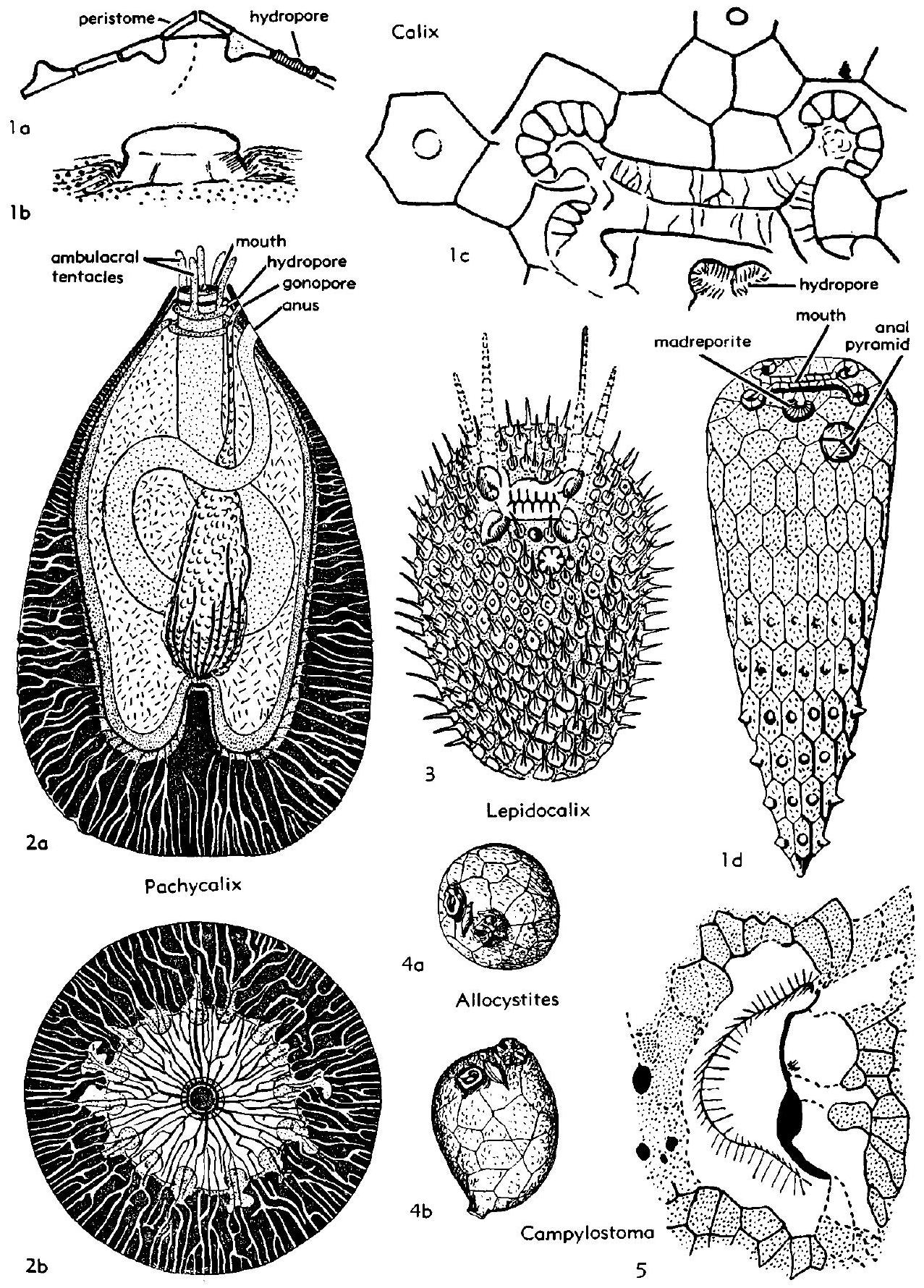 Fig. 143,1. *C. sedgwicki, M. Ord., Fr., 1a, section through peristome and hydropore; 1b, internal mold of peristome; 1c, diagram of oral region (34), 1d, reconstr., about X0.2 (128).
Synonyms
Dorycystites
Geographic Distribution
Eu.(Boh.-Fr.-Port.-Spain)
Age Range
Beginning Stage in Treatise Usage:
M.Ord.
Beginning International Stage:
Dapingian
Fraction Up In Beginning Stage:
0
Beginning Date:
471.26
Ending Stage in Treatise Usage:
U.Ord.
Ending International Stage:
Hirnantian
Fraction Up In Ending Stage:
100
Ending Date:
443.07
Description
Theca cylindrical to conical or carrot-shaped, very elongate, bearing aboral terminal tubercle, very large, attaining height of 40 cm, composed of about 2,000 small plates in adult form, many with central tubercle or prominence. Mouth elongate, with brachiole facet at each end. Diplopores with simple oval or slightly curved pits covered over by epitheca, which seldom is preserved. Chauvel (33) differentiated 3 stages of development in type species: (1) aboral zone composed entirely of primary plates bearing tubercles, (2) appearance of secondary or supplementary plates between tuberculiferous plates (single circle of secondary between 2 circles of tuberculiferous primaries), and (3) appearance of secondary tubercles on primary plates, secondary plates, and possibly on plates of oral zone. Top of theca comprising corona of 8 to 12 plates without diplopores, anal pyramid with 6 triangular plates,
References
Museum or Author Information
Classification
Phylum:
Echinodermata
Subphylum:
Crinozoa
Class:
Cystoidea
Order:
Diploporita
Superfamily:
Sphaeronitida
Family:
Aristocystitidae
Formal Genus Name and Reference:
Calix ROUAULT, 1851, p. 358
Type Species:
C. sedgwicki, OD
Images
(Click to enlarge in a new window)
Fig. 143,1. *C. sedgwicki, M. Ord., Fr., 1a, section through peristome and hydropore; 1b, internal mold of peristome; 1c, diagram of oral region (34), 1d, reconstr., about X0.2 (128).
Synonyms
Dorycystites
Geographic Distribution
Eu.(Boh.-Fr.-Port.-Spain)
Age Range
Beginning Stage in Treatise Usage:
M.Ord.
Beginning International Stage:
Dapingian
Fraction Up In Beginning Stage:
0
Beginning Date:
471.26
Ending Stage in Treatise Usage:
U.Ord.
Ending International Stage:
Hirnantian
Fraction Up In Ending Stage:
100
Ending Date:
443.07
Description
Theca cylindrical to conical or carrot-shaped, very elongate, bearing aboral terminal tubercle, very large, attaining height of 40 cm, composed of about 2,000 small plates in adult form, many with central tubercle or prominence. Mouth elongate, with brachiole facet at each end. Diplopores with simple oval or slightly curved pits covered over by epitheca, which seldom is preserved. Chauvel (33) differentiated 3 stages of development in type species: (1) aboral zone composed entirely of primary plates bearing tubercles, (2) appearance of secondary or supplementary plates between tuberculiferous plates (single circle of secondary between 2 circles of tuberculiferous primaries), and (3) appearance of secondary tubercles on primary plates, secondary plates, and possibly on plates of oral zone. Top of theca comprising corona of 8 to 12 plates without diplopores, anal pyramid with 6 triangular plates,